Great Karoo
Heart of the HunterThe Great Karoo is a decisive passage in Thobela Mpayipheli’s flight across southern Africa: a wide, sparsely described landscape whose long distances and punishing weather test his ability to keep moving, while a storm briefly defeats the helicopters pursuing him. It is not simply scenery between destinations. Here, fuel, visibility, road choices, and the need for sleep become immediate conditions of survival.
Setting and Route
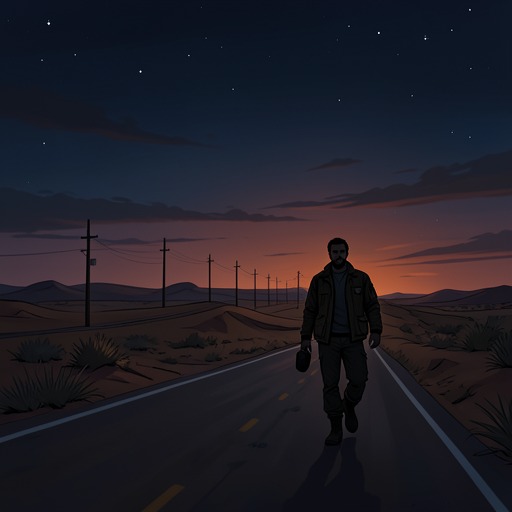
The Great Karoo lies on the route Mpayipheli is calculating after leaving the Cape. Beyond Touws River, as the bends fall away, he can turn his attention from the motorcycle to the journey ahead. The fuel gauge indicates that he must stop at Laingsburg; from there, Beaufort West is another 200 kilometres away, across a highway he understands as wide and straight, oppressively hot by day and soul-destroying at night. His estimated arrival is around midnight.
Beyond Beaufort West, he reckons on a further 500 or 550 kilometres to Bloemfontein. Reaching it before sunrise seems possible only if he pushes on and makes his refuelling stops quickly. He expects that he will need to sleep in Bloemfontein, finding somewhere to rest in a Black township during daylight. The route is therefore measured not just in kilometres but in the changing demands of darkness, fatigue, fuel, and concealment.
A Route That Keeps Changing
Mpayipheli’s plans remain provisional. At one point he intends to refuel in Beaufort West, ask about the distance and road conditions to Bloemfontein, and then take the road to Kimberley at Three Sisters. Later, he thinks instead of finding a shaded, screened place in the veld beyond Three Sisters to sleep once the sun is up. Sleep deprivation is a practical danger: he knows poor judgment can produce bad decisions, even as he resists wasting the darkness by stopping.
His thoughts also turn to the intelligence pursuers and to the contents of the disk that have made him their target. The Great Karoo’s open road offers distance, but the journey is not a simple race along a fixed line. Mpayipheli must continually weigh speed against rest and exposure, while those searching for him try to anticipate which way he will go. The route eventually bends away from the direct passage through Bloemfontein: Janina Mentz traces a stronger possibility westward through Gaborone, Mmabatho, Vryburg, and Kimberley.
Storm and Pursuit
The weather transforms the Karoo from an exhausting corridor into a moment of danger and opportunity. A vast storm rolls across the plains, announced by thunder and lightning. Captain Tiger Mazibuko, trying to organize a roadblock in the rain, studies the available side roads: one turns east toward Nelspoort, another forks west toward Wagenaarskraal. His force has too few men and vehicles to guard every alternative effectively. Four members of the Reaction Unit must be sent out in pairs on foot, while Mpayipheli has a motorcycle and the rain makes visibility terrible.
The helicopters close in over Mpayipheli, flying low and then following behind him. His speedometer passes 200 kilometres per hour, but the storm ahead forces him to slow. Rain sheets across the highway; spray and darkness make it difficult to see other vehicles, and the truck in front of him further limits his options. When the rain deepens, the helicopters’ noise fades. The storm that has made the road more treacherous also breaks the pursuit’s immediate grip.
That reprieve is incomplete. Mpayipheli falls on a gravel road and must continue through mud at reduced speed, cold, wet, tired, and sore. He estimates that Kimberley is still five or six hundred kilometres away. Mentz, watching the clock against the seventy-two-hour deadline, notes that twelve hours have passed and sixty remain. The weather has opened a gap, but it has not removed the distance or the danger.
The Karoo as a Test of Movement
The Great Karoo’s narrative importance lies in the way its scale makes movement costly and calculation indispensable. Long stretches between Laingsburg, Beaufort West, and the next major destination impose their own timetable; fuel stops and sleep cannot be ignored, while the open road exposes Mpayipheli to surveillance and interception. Rain then reverses the apparent advantage of that exposure: it hinders his riding and leaves him vulnerable on gravel, yet also helps him lose the helicopters.
After the pursuit, Mpayipheli is carried in the back of a Chevrolet El Camino beneath a dirty, paint-flecked tarpaulin, curled on an old mattress beside the motorcycle and among salvaged furniture and luggage. The rain has nearly passed, with only occasional showers tapping the covering. His immediate passage through danger has become a cramped, concealed ride toward Loxton. Across these episodes, the landscape is neither a neutral backdrop nor a guaranteed refuge: it continually changes what speed, shelter, and escape can mean.